

React and Angular are two of the most popular frontend technologies used in modern web development. Both tools help developers create interactive websites and web applications, but they follow different approaches and development philosophies. Beginners entering the world of programming often compare React and Angular to determine which technology is easier to learn and better suited for future career opportunities.
Choosing between React and Angular can feel confusing because both technologies are powerful, widely used, and supported by major technology companies. React focuses mainly on building user interfaces with flexibility and simplicity, while Angular provides a complete framework for developing large-scale applications. Understanding their differences, strengths, and learning paths helps beginners make better decisions before starting frontend development careers.
Quick Comparison Table
| Feature | React | Angular |
|---|---|---|
| Type | JavaScript Library | Full Frontend Framework |
| Developed By | Meta | |
| Initial Release | 2013 | 2016 (Angular 2+) |
| Programming Language | JavaScript / TypeScript | TypeScript |
| Main Purpose | Building User Interfaces | Building Complete Web Applications |
| Learning Curve | Easier for beginners | Steeper and more complex |
| Architecture | Component-Based | MVC and Component-Based |
| DOM Handling | Virtual DOM | Real DOM with Change Detection |
| Flexibility | Highly flexible | Structured and opinionated |
| Performance | Fast UI rendering | Strong for enterprise apps |
| State Management | External libraries often needed | Built-in tools available |
| Best For | Dynamic UI applications | Large-scale enterprise projects |
| Mobile Development | React Native support | Ionic and Angular-based solutions |
| Community Support | Very large community | Strong enterprise community |
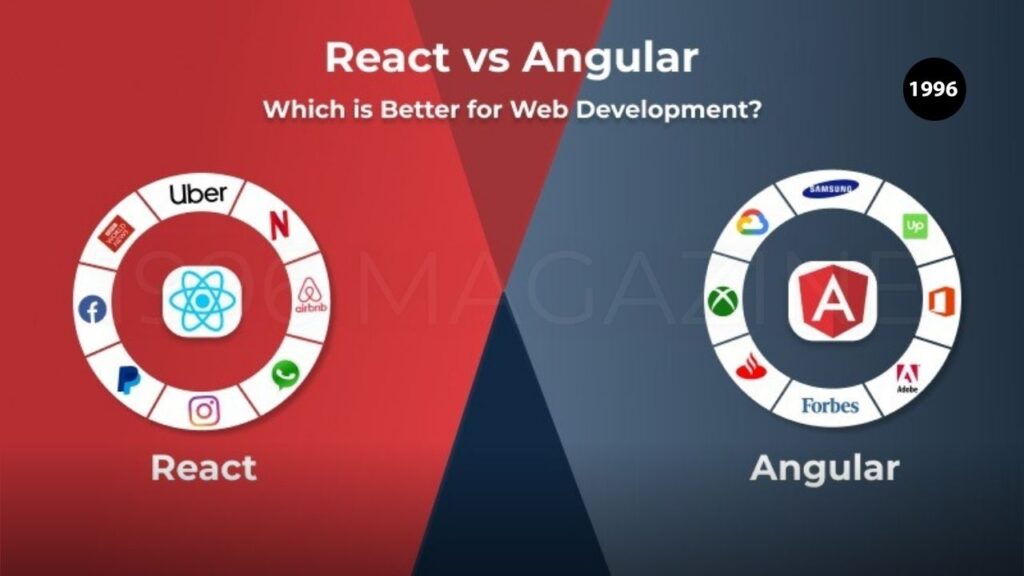
| Popular Companies | Netflix, Instagram, Airbnb | Google, Microsoft, Forbes |
| SEO Support | Good with SSR frameworks | Strong built-in support |
| Development Speed | Faster setup and customization | Structured but heavier setup |
| Scalability | High with proper architecture | Excellent for enterprise scaling |
| Career Demand | Very high globally | High in enterprise sector |
| Beginner Friendly | More beginner-friendly | Better for experienced developers |
What Is React?
React is a JavaScript library developed by Meta for building fast and interactive user interfaces. It focuses mainly on the view layer of web applications, allowing developers to create reusable UI components efficiently. Because of its flexibility and relatively simple structure, React became extremely popular among startups, tech companies, and independent developers worldwide.
One of React’s biggest strengths is its component-based architecture, which allows developers to break interfaces into smaller reusable parts. This approach improves code organization and simplifies maintenance for large applications. React also uses a Virtual DOM system that improves rendering speed and overall application performance, making it ideal for modern dynamic web applications.
What Is Angular?
Angular is a complete frontend framework developed and maintained by Google. Unlike React, which mainly handles user interfaces, Angular provides a full development solution including routing, state management, dependency injection, and form handling within a single framework structure. This makes Angular especially suitable for enterprise-level applications and large development teams.
Angular uses TypeScript as its primary language, adding strong typing and advanced programming features to JavaScript development. Although Angular has a steeper learning curve, many developers appreciate its organized structure and built-in tools. Large companies often prefer Angular because it supports scalable architecture and consistent development practices across large projects.
History and Background of React and Angular
React was released by Meta in 2013 to improve dynamic user interface development within large-scale applications. It quickly gained popularity because of its flexibility, reusable components, and high performance. Developers appreciated React’s simple learning process compared to heavier frontend frameworks available during that time.
Angular has a longer history that began with AngularJS, which Google later redesigned into the modern Angular framework released in 2016. This updated version introduced TypeScript support and a more powerful architecture focused on enterprise application development. Both technologies evolved significantly over time and now dominate frontend development industries worldwide.
Core Features of React
React offers several features that make frontend development easier and faster for modern applications. Its component-based system encourages reusable code, reducing duplication and improving project organization. React also supports one-way data binding, helping developers manage application state more predictably and efficiently.
Another important feature is React’s Virtual DOM, which optimizes rendering performance by updating only necessary parts of the interface instead of refreshing entire pages. React’s ecosystem also includes tools like React Router and Redux, which expand functionality for routing and state management in larger applications.
Core Features of Angular
Angular includes many built-in features that simplify enterprise application development. Developers receive integrated solutions for routing, HTTP requests, form validation, dependency injection, and state management without needing multiple external libraries. This all-in-one structure makes Angular highly organized and suitable for large development environments.
Angular also supports two-way data binding, allowing automatic synchronization between the application model and user interface. In addition, Angular’s strong TypeScript integration improves code reliability, scalability, and maintainability. These features make Angular especially attractive for complex business applications and corporate development teams.
React Architecture Explained
React follows a component-based architecture where interfaces are divided into reusable UI components. Each component manages its own logic and rendering behavior, making applications easier to maintain and update. This modular structure helps developers create scalable applications without tightly coupling different interface sections together.
f(x)=UI(Component1)+UI(Component2)+UI(Component3)
React applications generally use unidirectional data flow, meaning information moves from parent components to child components in a predictable direction. This structure improves debugging and state management, especially when applications become larger and more complex over time.
Angular Architecture Explained
Angular uses a structured architecture based on modules, components, services, and dependency injection systems. Unlike React’s lightweight library approach, Angular provides a full application framework designed for large and scalable enterprise systems. This architecture promotes consistent coding standards and organized project structures.
Application=Modules+Components+Services+Routing
Angular applications separate responsibilities clearly between services, templates, and business logic, improving maintainability for large teams. Although this structure increases complexity for beginners, it creates highly scalable systems capable of supporting advanced enterprise applications efficiently. Read more Nick Jonas
Learning Curve for Beginners
React is generally considered easier for beginners because developers mainly need basic JavaScript knowledge before starting. Its smaller learning scope allows newcomers to build projects quickly while gradually exploring advanced concepts later. Many students and self-taught developers choose React because of its beginner-friendly environment and flexible learning process.
Angular has a steeper learning curve because it introduces TypeScript, dependency injection, modules, decorators, and many built-in systems simultaneously. Beginners may initially feel overwhelmed by Angular’s complexity and structured environment. However, developers who master Angular often gain strong understanding of scalable application architecture and enterprise-level programming practices.
Performance Comparison Between React and Angular
React is widely praised for excellent rendering performance because of its Virtual DOM implementation. Instead of updating entire pages, React efficiently updates only changed components, improving speed and responsiveness for interactive user interfaces. This optimization makes React highly effective for dynamic applications with frequent user interactions.
Angular also offers strong performance, especially for enterprise applications, but its larger framework structure can increase initial application size and complexity. Angular uses change detection mechanisms that efficiently track application updates, though React generally performs better in lightweight and highly dynamic interfaces requiring fast rendering speeds.
User Interface and Development Flexibility
React provides developers with significant flexibility regarding project structure, external libraries, and development decisions. This flexibility allows teams to customize applications according to specific requirements and preferred technologies. Developers can choose routing libraries, state management systems, and additional tools independently within React projects.
Angular follows a more opinionated development style with predefined structures and built-in solutions. While this reduces flexibility compared to React, it creates consistency across large teams and enterprise projects. Beginners who prefer structured guidance may appreciate Angular’s organized approach, while others may prefer React’s adaptable environment.
State Management in React and Angular
State management controls how applications handle changing data and user interactions during runtime. React typically requires additional libraries like Redux or Context API for managing complex application state across multiple components. This flexibility allows developers to select solutions based on project size and requirements.
Angular includes several built-in tools supporting state management and data handling within the framework itself. Services and dependency injection systems help developers manage application logic efficiently without relying heavily on external packages. Enterprise teams often appreciate Angular’s integrated approach for large-scale application management.
Community Support and Ecosystem
React has one of the largest frontend development communities globally, resulting in extensive tutorials, documentation, libraries, and online resources for beginners. Developers can easily find solutions, plugins, and support through forums, videos, and educational platforms dedicated to React development.
Angular also maintains a strong global community, especially among enterprise developers and corporate technology teams. Google’s support ensures long-term framework stability and regular updates. While Angular’s community is slightly smaller than React’s, it remains highly active and valuable for developers building large applications.
Job Market and Career Opportunities
React developers are currently in extremely high demand because many startups and technology companies use React for modern web applications. Learning React opens opportunities in frontend development, mobile application development through React Native, and full-stack JavaScript environments.
Angular developers are also highly valued, particularly in enterprise sectors involving large business applications and corporate software systems. Companies requiring scalable architectures often prefer Angular because of its structured development environment. Both technologies provide strong career opportunities depending on industry focus and project requirements.
Advantages of Using React
React offers several advantages including flexibility, reusable components, strong performance, and easier learning for beginners. Developers can quickly build interactive interfaces while customizing project architecture according to personal or business preferences. React’s ecosystem also supports mobile development through React Native, increasing career possibilities significantly.
Another advantage is React’s massive community and rich library ecosystem, which simplify problem-solving and learning processes. Because React focuses mainly on interfaces rather than full application structures, developers can integrate it easily into existing projects without major architectural changes.
Advantages of Using Angular
Angular provides a complete framework with built-in solutions for routing, forms, dependency injection, and application management. This integrated environment simplifies large-scale development and reduces dependency on third-party libraries for enterprise applications.
Angular also promotes consistent architecture and maintainable coding standards across development teams. TypeScript integration improves code reliability and scalability, making Angular especially beneficial for business applications requiring long-term maintenance and large collaborative development environments. Explore more here.
React vs Angular: Which One Should You Choose?
Choosing between React and Angular depends mainly on personal goals, project requirements, and preferred learning styles. Beginners seeking faster learning and flexible development often choose React because it simplifies entry into frontend development. React is especially effective for startups, dynamic interfaces, and modern interactive applications.
Angular may be the better choice for developers interested in enterprise software, structured architectures, and full-featured frameworks. Although Angular requires more learning initially, it provides strong foundations for scalable application development. Both technologies are excellent career choices, and learning either can lead to valuable opportunities in modern software industries.
Conclusion
React and Angular are two of the most important frontend technologies shaping modern web development today. React focuses on flexibility, speed, and reusable UI components, making it highly beginner-friendly and popular among startups and modern application developers. Angular offers a complete framework with strong architecture and enterprise-level scalability suited for large business applications.
For beginners, React is often easier to start with because of its simpler learning curve and flexible ecosystem. However, Angular provides powerful tools and structured development practices valuable for enterprise careers. Ultimately, both technologies offer excellent career opportunities, and choosing the right one depends on individual learning preferences and professional goals.
Frequently Asked Questions
Is React easier than Angular?
Yes, React is generally considered easier for beginners because it has a simpler learning curve.
What is Angular mainly used for?
Angular is mainly used for building large-scale enterprise web applications.
Which company developed React?
Meta, formerly Facebook, developed React.
Does Angular use TypeScript?
Yes, Angular primarily uses TypeScript for development.
Which technology is more popular?
React currently has broader popularity among startups and frontend developers globally.
Stay More Update 1996 MAGAZINE